A Retired Military Doctor Told Me Something at a Party in Ibadan That Fixed in 7 Nights What I Had Been Carrying — Quietly, Alone — for Seven Months

I want to be honest with you about something I have never said out loud to anyone.
For seven months last year, I was quietly terrified of my own wife.
Not terrified of her, exactly. Terrified of what would happen if she reached for me in the night and my body did not cooperate. Again.
So I developed a routine. Stay up late. Phone in hand, pretending to watch something. Wait until I could hear her breathing change. Then slide in carefully, face away, not touching. Like a man defusing a bomb in his own bedroom.
If you are reading this and you know exactly what that feels like — I wrote this for you.
Because I carried it the way Nigerian men carry things. Silently. With a straight face. Telling myself it was stress, it was the business, it would pass. Meanwhile I was quietly buying Wellman vitamins in double quantities from the pharmacy near my office and praying no one behind me in the queue was someone I knew.
(It did not work. The Wellman. Just so we are clear.)
I was 41. I ran a logistics company. I had a wife I loved, three contracts in delay, and a mother in Anambra who called every Sunday expecting a cheerful son. I was managing all of it with a smile I had practiced so many times it no longer required effort.
What I was not managing was the one thing happening — or not happening — in my bedroom.
And I had no one to tell. Because a Nigerian man does not say this thing. Not to his friends at the barber. Not to his brother over the phone. Not even to his doctor, because what doctor in this country is prepared to sit with you past the five-minute appointment and actually discuss something like this without making you feel like you are being assessed?
So you carry it. And the carrying itself becomes its own kind of prison.
"I'm not a medical person. I'm just a man who found something that worked — and couldn't keep it to himself."
My name is Emeka. I run a logistics operation out of Lagos — mostly haulage between the ports and distribution centers in the Southwest. Not a glamorous business. A lot of calls, a lot of delays, a lot of problems that only you can solve because you built the thing.
I am not a doctor. I am not a health coach. I am the last person who should be writing something like this, honestly. But here we are.
The problem started — as these things do — with no dramatic starting point. One month things were fine. Then they were a little less fine. Then somehow seven months had passed and I had become an expert at strategic avoidance inside my own marriage.
My wife, God bless her, did not say anything. But I noticed the small things. The way she stopped asking why I was always on my phone so late. The way she started keeping her own side of the bed with a kind of deliberate respect that was somehow worse than if she had just confronted me directly.
I tried the obvious things. I exercised for a month straight — gym three mornings a week, which for a man who parks as close to the entrance as possible at every location, was significant. I cut alcohol. I bought a blender and started making vegetable smoothies my driver made faces at every morning. I even tried one of those Instagram supplements — the kind with the video testimonials of men looking shocked and grateful. All it did was make me burp for three days.
Nothing worked.
Then in December, my wife and I drove to Ibadan for Chief Adeyemi's retirement party. The man had been in the industry since before I was born. Big owambe. The kind where they bring out the Owambe jollof in the big pots and there are at least four different sizes of the same aso-ebi.
At some point during the evening — food in one hand, drink in the other, pretending to enjoy myself — I ended up standing near the drink table next to an older man I did not recognise. Calm face. The kind of man who has stopped trying to impress anyone. We made small conversation. Traffic from Lagos. How long he had known the Chief. The usual nothing.
I still cannot explain what made me say what I said next. Maybe it was the third small stout. Maybe it was just seven months of carrying something alone finally finding a crack to leak through. I told him I had been having a difficult year. That stress was affecting me. That I was "not quite myself."
He looked at me a moment.
"What kind of not yourself?"
Something in the way he asked — no alarm in it, no judgment — made me tell him the actual truth instead of the polished version.
He nodded. He told me he was a retired military physician. Thirty years treating soldiers and high-ranking officers — men whose entire profession involved performing under extreme pressure while showing none of it. He had seen what I was describing hundreds of times.
"The problem," he said, "is not your age. And it is probably not what you think it is. What you are describing is what happens when cortisol — your stress hormone — stays elevated for months. It suppresses testosterone directly. The two cannot comfortably share space. And modern life, especially for a man running a business in this country, is a cortisol factory."
He asked me a strange set of questions. What did I eat after 7pm? Did I sleep in a completely dark room? What was my exact routine in the thirty minutes before bed? Did I ever do any breathing exercises? I told him I did not have time for breathing exercises.
He smiled at that.
He described a protocol. Seven evenings in a row. Specific things, in a specific order. One mineral supplement — available at any pharmacy, he said, for under five hundred naira — that most Nigerian men are chronically deficient in without knowing. Three foods to eliminate immediately. A four-minute breathing sequence. Some adjustments to the bedroom environment that sounded almost too simple to be worth mentioning.
I listened. I nodded. Inside I was thinking: this man is describing a bedtime routine. I have been dealing with this for seven months and a retired doctor at a party in Ibadan wants me to do a bedtime routine.
But what was I going to do — argue with him? I had tried everything else.
I started the Sunday night we got back to Lagos. Night one, nothing. Night two, nothing — and I almost stopped, because of course nothing was happening, it was a bedtime routine. Then Night 3, I slept in a way I had not slept in months. I woke up at 5:30am without an alarm and I just lay there thinking: something is different. I could not name what. Just different.
By Night 5, I understood what different meant.
By Night 7, my wife and I were together properly for the first time in seven months. Afterwards, she just looked at me.
"Emeka. What is going on with you?"
I told her I had been sleeping better. Which was true. She did not push further. She just smiled and turned over. I stared at the ceiling for a while.
It was the best ceiling I had ever seen.
I quietly shared the protocol with a few men I trusted. Biodun, who is a civil servant in Abuja and had been dealing with the same thing. Chukwuemeka from Port Harcourt — a man who is very proud, and who called me three weeks later and simply said: "It worked. Don't ask me anything else."
One man — I won't mention his name because he would kill me — sent a message at 11pm on a random Tuesday. Just three words: "We are expecting."
After it had worked for enough men that I stopped being surprised, I decided to write it all down properly. Every step. Every detail. Not as a health expert — I am not one. Just as a man who found something, tested it, and watched it work for others.
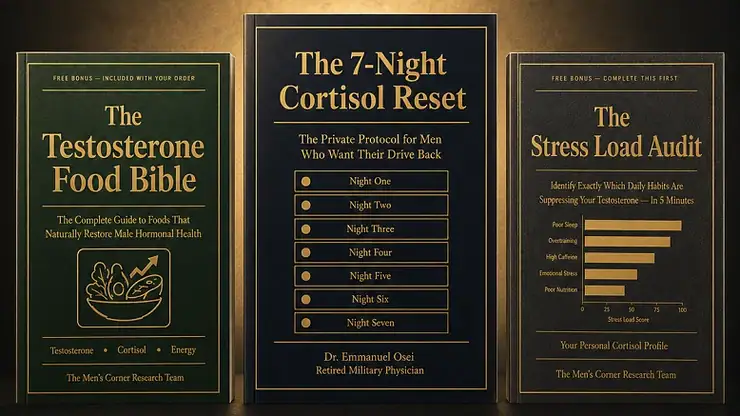
I put everything into one straightforward guide. The full protocol exactly as Dr. Osei described it. The mineral, the foods to avoid, the breathing sequence, the sleep environment adjustments. How to know it is working before Night 7. How to maintain it long-term without turning your life into a health project.
The 7-Night Cortisol Reset
The Private Protocol for Men Who Want Their Drive Back
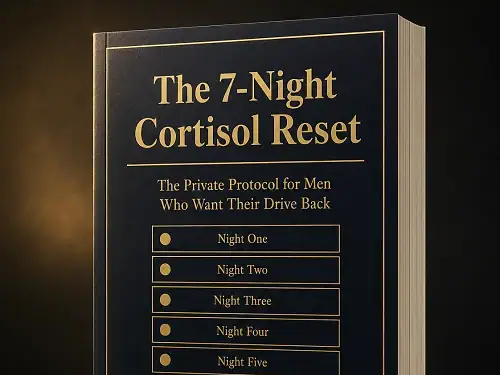
Inside this e-guide, you'll discover:
- Why this is almost certainly a cortisol problem — not an age problem, not a discipline problem — and why every solution you've already tried was aimed at the wrong target — Pg. 3
- The complete 7-Night Evening Protocol — every step, every timing, in plain language — written so a tired man can follow it on the first night without reading it twice — Pg. 7
- The one mineral deficiency silently suppressing testosterone in most Nigerian men — under ₦500 at any pharmacy, and almost no one is using it correctly — Pg. 12
- 3 specific Nigerian foods that are actively working against you — especially eaten at night — at least one of them is probably a regular part of your evening — Pg. 15
- The 4-minute breathing sequence that begins lowering cortisol within 20 minutes — no equipment, no special location, no YouTube tutorial required — Pg. 18
- What to watch for before Night 7 that tells you the protocol is working — so you do not give up on Night 3 the way I almost did — Pg. 21
- How to maintain the results with roughly 10 minutes a day — because fixing it and keeping it are two different conversations — Pg. 24
No hospital visits. No prescriptions. No explaining anything to anyone. Your wife doesn't need to know you searched for this until she starts wondering what has changed about you — and she will wonder.